
Imagine you’re headed straight to a yoga class with one of your favorite teachers after a busy day at work. It was one of those days where you felt like you’d ‘barely had a moment to breathe’ — your phone kept ringing and somehow the to-do list grew faster than you could check items off of it. Rush-hour traffic is crazy and you find yourself anxious that you might miss class. Your breath is shallow and you say aloud, “please don’t let me miss this class, I’ve been looking forward to it all day” as you dreadfully examine the long line of brake lights.
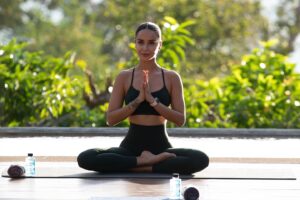
Luckily, you make it to class with only a few minutes to spare. You roll out your mat, sit down, and take a deep exhale. “Phew, I’m here.”
Breath as the Foundation of Yoga
The yoga teacher begins class by guiding you through a few minutes of diaphragmatic breathing (also known as 3-part breath or Dirga Pranayama). You immediately notice that your heart rate and your thoughts have slowed down, and the stress that had been pulsing through your body all day seems to depart along with your deep, intentional exhales.
The teacher explains that in yoga, the practice of breath control is called Prāṇāyāma. It is a conscious regulation of the breath as a way of engaging with prāṇa, our life force energy. In this way, Prāṇāyāma is literally life-giving. That makes sense — you feel more alive now than you had all day.
The Nervous System & the Language of Breath
Perhaps you can relate to this scenario. As we saw, your breath directly reflects the state of your nervous system. When you are stressed, rushed, or anxious, you’ll find yourself taking shallow, uneven breaths, which land in your chest. When you are calm and at ease, you’ll find yourself taking deep, steady, nourishing breaths that seem to fill your entire body with energy.
By consciously deepening your breath, you activate your parasympathetic nervous system, which is the “rest and digest” part of your autonomic nervous system, balancing the “fight or flight” sympathetic system that is activated when we are in a state of stress. Our breath is a mirror for our inner world — by becoming aware of it, we gain insight into the state of our nervous system and mind. We then have the opportunity to consciously slow down and shift gears into a space of ease.
Breath in Asana — Moving From Shape to Sensation
You may find yourself moving through postures without fully allowing the breath to support the movement — holding it, or stretching it longer. When breath and movement are out of sync, we may rely on physical effort alone. But when each inhale and exhale fully carries us through a transition or a shape, something shifts. The breath begins to fuel the posture rather than force it.
When breath and movement fall out of sync, it often signals one of two things: your attention has wandered away from the present moment, or you’re pushing beyond a place where the breath can move freely. Both invite you to soften and ease back into the pose. By actively linking breath and movement, the practice becomes more embodied and you settle into a more meditative flow.
Pranayama as a Standalone Practice
While breath naturally weaves itself throughout an asana practice, pranayama can also be practiced on its own as a powerful way to shift energy, regulate the nervous system, and cultivate awareness. Even a few minutes of intentional breathing can create noticeable changes in how you feel. Below are two practices you might consider incorporating into your daily routine.
In the morning, when you’re looking to awaken your body and clear your mind, Kapālabhāti (Skull-Shining Breath) is a great practice. Sit comfortably with a tall spine, take a deep inhale, then begin a series of short, active exhales through the nose. Your inhales will happen naturally in between the exhales. Begin with 20–30 rounds of breath. This practice is energizing and invigorating, helping to shake off sluggishness and invite clarity into your day. As with all breathwork, this practice should feel steady and accessible — if dizziness arises, pause and return to natural breathing.
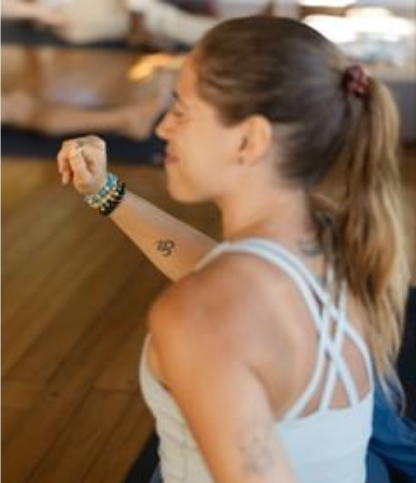
In the evening, when you’re ready to unwind and settle, Nadi Shodhana (Alternate Nostril Breathing) offers a deeply balancing and grounding practice. Using your right hand, fold down your index and middle fingers. Take a breath in, gently close your right nostril with your thumb as you exhale through your left nostril. Inhale through your left nostril, then plug your left nostril with your ring and pinky finger and exhale through the right. Then inhale through the right nostril, and continue alternating for several rounds. Allow the breath to be smooth and even, with the option to count to 4 or 6.
Closing
We are constantly breathing — whether we are aware of it or not. Our breath subtly responds to every situation, emotion, and thought. When we learn to listen to it, we gain access to a powerful guide that brings us back into the present moment again and again. Whether on the mat or in daily life, returning to the breath offers an invitation to slow down, soften, and reconnect. The next time you find yourself feeling rushed or overwhelmed, remind yourself to pause for a moment and simply breathe. Just a couple minutes of intentional breathing can lead to a profound shift.